Open navigation menu

Switchboard vs Run Anywhere
Switchboard unlocks an entirely new class of interactive live experiences.
Follow us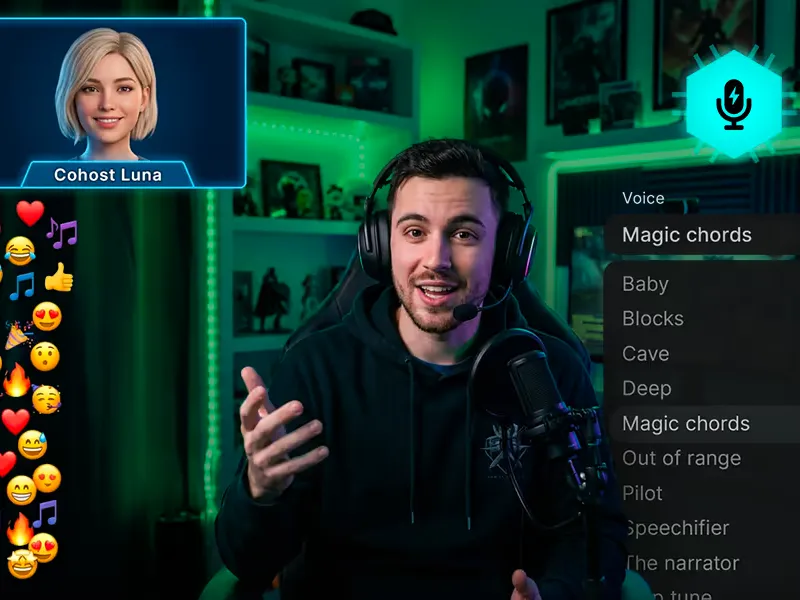
Live streams with voice AI, music, watch parties, audience participation, and other interactive features require treating audio as a shared, real-time system. Here’s why:
Imagine you’re building an interactive live streaming app. The core idea is simple: creators go live, but instead of streaming alone, they have an AI co-host alongside them. It jokes, reacts, asks questions, keeps the energy up. Viewers can jump in with their voice, not just chat. Music plays in the background, shifting with the mood of the stream. The goal isn’t just content—it’s a show, something that feels alive.
The first version comes together quickly. You wire up a streaming stack, add a text chat, and you’re off and running with a simple, Twitch-like experience in no time. Later, you start experimenting with new interactive features: you plug in a voice AI system and layer in music playback. Individually, everything works. The AI can speak. The audience can join. The creator can interact. But when you run it end-to-end, something feels off. The AI seems out of sync. You can’t hear the voices over the music. The audio glitches out when you background the app. People are talking over one another. The AI tries to interject but either cuts someone off or misses the moment entirely.
So you start patching. You add rules for who gets priority when multiple people talk. You hack in volume ducking for music. You try buffering audio to smooth things out. You track state across systems—who’s speaking, who should speak next, when the AI is allowed to jump in. It seems to get better around your test cases, but it’s also more fragile. Every new feature—another AI personality, more audience participation, sound effects—makes the system harder to control. The experience never quite locks in. It feels like a collection of features, not a cohesive environment.
Eventually, you realize the issue isn’t the quality of the models or the speed of the pipeline. It’s that you’ve built multiple independent audio systems and you’re trying to make them behave like one. The AI isn’t actually in the stream, it’s reacting to it from the outside. The music system doesn’t know about the voices. The audience voices don’t share timing with the AI. There’s no single place where all sound is coordinated, so everything is slightly out of sync, competing, and feels off. And it gets worse every minute.
When you rebuild it with Switchboard, the architecture flips. Instead of separate pipelines, there’s one shared audio system. The creator’s mic, the audience voices, the AI co-host, and the music all exist in the same environment, on the same timeline. The AI isn’t reacting to delayed inputs—it’s listening to the same stream as everyone else. When it speaks, it’s mixed intentionally with everything else. When someone interrupts, the system doesn’t scramble—it just routes and prioritizes audio in real time.
And that’s when the product finally clicks. The AI laughs on beat. The music ducks just the right amount when someone speaks. Overlapping voices feel natural and conversational instead of chaotic. Adding complexity doesn’t break things—it enhances them. What you built isn’t just a streaming app with features bolted on. It’s a live system where humans, AI, and media all coexist in the same space. That difference sounds subtle in architecture, but it’s obvious in experience. And when users experience it, there’s no going back.
The more interactive the experience, the more you need Switchboard to manage the parallel audio streams. Add multiple target operating systems and device combinations and there’s essentially no realistic alternative.
If you’re building at the intersection of live streaming, media, and voice AI, you’re the reason we built Switchboard. The crazier the idea, the better the fit, the more fun to work on. And we love working with pioneers in this space.